Believe What You Like But Know What You Must

People are free to be consumed with contemplating their existence, their origins, the origins of the universe, supreme beings, controllers of destiny or anything else. But solving "the Great Mystery" is neither a requirement of being Ohnkwe Ohnwe nor does it provide a path to righteousness. I maintain that spirituality does not require faith or the leaps that faith requires but rather awareness. If it helps to believe that "God has a plan" and we just must have faith that "He" knows what "He" is doing, then walk that path. My interest is in taking the mystery out of life by pointing to the obvious that is ignored everyday in the midst of fanatical ideology and the sometimes not too subtle influences of promoting beliefs over knowledge. I have said it before: “beliefs are what you are told, knowledge is what you experience”. I support a culture that prepares us to receive knowledge and to live a life with purpose. I am certainly not suggesting there is only one way to do that.

"Let's Talk Native..." on the LTN Radio Network

"Let's Talk Native..." on the LTN Radio Network
Click the LTN Banner above for a link to the "Let's Talk Native…" feed on Unity Stream
_________________________________________________________________________________________________________________________________ ______________________________________________________________________

__________________________________________________________________________________________________ ________________________________________________________________________________

Donate to "Let's Talk Native"

Sunday, November 1, 2009

The Hearing


On October 27, 2009 the New York State Senate Committee on Investigations and Government Operations held a hearing in New York City to discuss enforcement of State taxes on Native sales of tobacco products.


OK then. That was interesting. Without question the Senecas stole the show. JC Seneca did a fair enough job delivering the message that we would neither be forced to collect State tax nor pay it. A few opportunities were missed, but by and large the ignorance and racism demonstrated by those that assemble in Albany was illuminated and pushed back. I think we were hurt in the areas of unity with other Native communities both by the words that were said and the fact that the Seneca entourage only stayed for the SNI testimony. Everyone knew the SNI would put a major emphasis on their regulatory system. In doing so it was clear that the SNI representatives would be trying to draw a distinction from the other Native communities. That could not have been made more obvious with the their boasting of their prohibition against conducting business with non federally recognized tribes. This was particularly offensive given the fact that the hearing was in New York City which is in the back yard of those Native communities on Long Island that do not have BIA recognition and, as a city, has been leading the fight against all of us. I am sure that I am not alone in my concern over the Seneca Nation participating in joint sting operations with State and federal regulators against our own and then bragging about it here.


Another opportunity was missed in addressing the Attea case. The SNI practically stipulated that the case supported the State's position rather than challenging its interpretation. See Attea is Not a Landmark Case Against Indians posted here back on April 21st.


The State senators seemed to be obsessed with the absence of court interpretations of treaties and indeed the SNI representatives also seemed too focused on treaties as the source of our rights and liberties. While the State tries to challenge any right or freedom that is not explicitly defined in treaty, the voices from our side failed to turn the table and assert that our sovereignty is not established in treaties and that it is the State that cannot establish any legal foundation for taxing us. These are not "Indian" treaties. They are US treaties. They were concocted by them, they were drafted by them and they were ratified by them. While all of these US treaties went to lengths defining what would remain of our lands, they merely affirmed and acknowledged our inherent and obviously pre-existing rights to and on our lands. They gave us nothing that could remotely be defined as "treaty rights", rather they defined the obligations that the US would incur for the transfers of lands. Included in those obligations were health and education services, certain payments and security against foreign and domestic oppression. Our right to trade and commerce as well as any other activity commercial or otherwise was never surrendered to anyone. It apparently never occurred to the State Senate committee members that the reason there is no New York State court cases relating to these issues is because, ultimately the State knows it can't win and we wouldn't concede if they did. There seems to be no sense by those who cannot understand that we don't just choose to rely on our rights as they are handed down through generations rather than relying on a white man in a black robe to tell us, but that it is our obligation. This obligation is to those that will come after us and it is to keep others from imposing their will on our people.


In an effort to appear cooperative at some level there also seemed to be too much concession on other tax issues. When pressed about income and other taxes there was no mention of those that challenge those tax obligations. It is not a broadly accepted notion that some taxes apply while others don't. Even many of those that pay certain taxes, do it under protest and look to the day that we are better situated to fight those as well. I think it is difficult to find any Native person who actually believes that any State of federal taxes should ever be levied against us.


It was encouraging to hear a few State senators go on the record supporting our position. It was not missed by anyone that the clearest and most unequivocal support came from one of the only black Senators, Senator Adams, at the hearing. Senator George Maziarz should also be commended for clarifying several points that were being mischaracterized and for standing up to a fellow Republican Senator (Golden) with his ignorant rants that demonstates some of the arrogance and racism that gathers in Albany. Senator Maziarz was also clear in his support and, as a Senator, offered the only first hand knowledge and genuine concern for the Native people living near the district he represents (WNY). I was also impressed by the comments of Jed Morey, a writer from the Long Island Press. Everyone should take the opportunity to review his brief statement. It is worthy of sharing and most of the Native people that attended left before his opportunity to speak.


It should be noted that while some travelled from Seneca territory to New York, a small dedicated group of predominantly young men tended a fire beside the New York State Thruway where it passes through the Seneca territory of Cattaraugus. Signs, placards and flags, including several Warrior flags were displayed for motorist and passersby to observe. The number of horns blown in support of the Native position on this issue indicated the support is wide. The fire was maintained through the night as were the constant sounding of support from the Thruway motorists. It is an easy judgement to make that far more people witnessed the demonstration on the side of the Thruway than will ever hear the rhetoric espoused at the hearing. All those who put in time at the fire should be commended.

Friday, October 23, 2009

Can They Really Be That Stupid?

It is amazing how many times you can hear a tribal, state or federal official say something stupid without anyone ever challenging their ignorance. A case in point was US Senator Charles, "Chuck", Schumer (D-NY) spitting out the old tired comments on the news about how Indians have no right to sell their products to non-Indians and that the state is losing millions, perhaps even billions to our illegal sales. Oh yeah, and there is the one about how the US Supreme Court ruled in 1994 that the state could collect taxes from our sales. The worse part about false comments like these is that they are not just said by state and federal officials, they are repeated by tribal councilors and their legal counsel as well.
My question is: are they really that stupid? After all these guys are educated, in fact most of them are lawyers. So why do they misquote and misinterpret laws, court rulings and basic social, political and legal points all the time. I honestly believe that they know what they are saying is wrong.
Chuck can't really believe it is illegal for us to market our regulatory advantages to consumers out of our territories. Every town, city, county, state and country work to develop and market trade and commerce advantages. He can't possibly be saying that his people can sell to our people, but we can't sell to them. Something else must be at play here.
The Governor can't be so stupid to suggest that the state law that allows everyone in New York to have in their possession up to 2 cartons of untaxed and unstamped cigarettes, allows those people the opportunity to buy those unstamped cigarettes anywhere available but from Native retailers. The State's first black governor can't be that racist.
Surely out of all those people who keep suggesting that there exists some landmark Supreme Court decision that allows New York State to interfere with Native commerce, that someone would actually read the case (DEPARTMENT OF TAXATION AND FINANCE OF NEW YORK et al. v. MILHELM ATTEA & BROS.). If just one of the television or print journalist that keeps referring to this case would read it then perhaps he would offer the correct interpretation which is that the non-native wholesaler, Attea, lost his challenge against the State where he claimed his license to do business with Indians, issued by the BIA, superceded State law. Sorry folks, nothing to see here. No "we got those damn Mohawks and Senecas" ruling here. Just another case where a bunch of overly assimilated Indians out west were beat up in their state courts and had their cases cited in a case that, at best, references us.(See the post; Attea is Not a Landmark Case Against Indians)
The bottom line is that while NY State may tax the purchases made by its residents for use in the state, it still can't tax our sales. Let's try saying it together. The State may be able to regulate the actions of its people (the purchase or use), but not the actions of our people (the sale). But again, let's be clear; the State allows all its people to purchase up to 2 cartons of unstamped cigarettes for use in the State. The burden to remit a tax for purchases beyond 2 cartons is and always has been on the consumer. The State even has a form for it (Form CG-15). Now a logical person would assume that if a New York resident could buy 2 cartons from North Carolina or the Philippines that he could certainly stop by the nearest Native retailer for that purchase as well.
So what about that Billion dollars the State wants and needs so desperately? Well as the governor's request to the US Attorneys for a threat assessment will reveal, it doesn't matter how much they inflate a revenue leakage number. Any attempt to shut down the Native cigarette business will cost money, not make it. There is neither a guarantee nor a likelihood that even if the State eliminated reservation sales all together without a fight that any thing close to the numbers the State claims to be losing would be realized. Driving consumers to out-of-state and black market sales will surely have a much bigger negative impact to the State than anything they imagine happens on our territories. Oh how the State must long for the days when only the Mob could deliver cheap cigarettes to consumers.
Getting back to the gullibility or complicity of tribal leaders. Just as I don't think the non-native voices weighing in on this subject are that stupid, I don't think the Native ones are either. Of course the only Native voices we are allowed to be heard are the tribal government voices. These guys are so conflicted they can't help but come across as ignorant. On one hand they want to kiss ass for a Casino in the Catskills. On the other they are trying to validate their existence as legitimate government officials by proving they can assert authority over their people. Their own self loathing will not allow them to admit the obvious; that they are powerless. The beauty of our sovereignty is that we are born with it. We don't win it in an election or have it granted to us by the federal or state government. Not one of these tribal councilors has the courage to say that every business on our land is a Nation business. Every Native retailer operates as a sovereign entity because our sovereignty is not vested in the state nor does it exist as a common right but rather an individual birthright. This simply doesn't seem sophisticated enough for tribal officials. They want to be just an Indian version of those who are trying to harm us. But the reality is that all the rhetoric from these guys means nothing. It is the People that the State is scared of. It is the People that will shut the Thruway down. It is the People that will block bridges. And it will be the People that will stand toe to toe with the police if the State tries to force its will on our territories. I doubt Jim Ransom or Barry Snyder will rank very high as a threat to the State. And certainly their attorneys, Dale White and Rob Porter will be looked at more as assets and team players of the State, definitely not a risk to them.
So what is going on here? Is it really just a case of these guys trying to repeat something enough times to make it appear true or is it all just posturing for something else? The other thing that Chuck mentioned the other night was how so many other "tribes" have entered into agreements with the states. If the States really had the right to shut us down why would they want a compact? I think it is too easy to jump to the conclusion that a Catskill casino is at the root of much of this. Gaming certainly has played a role in shifting control of our land and people to the states, but gaming isn't the end game; the control is. I believe that the Mohawk and Seneca People have been the symbol of resistance, not only for Native people in the US and Canada, but world wide. The fact that neither US law nor their enforcers can reconcile our existence is a significant thorn for them. There are plenty of those "tribes" that drank the Kool-aid and entered all kinds of compacts. While they spent the last few years regretting that decision our territories continued to fight and maintain a strong private sector economy. Perhaps they should be asked how things have worked out for them. In spite of the fact that gaming compacts were leapt at in Mohawk and Seneca territories, the State still has not been able to control the people, not even by proxy through the tribal councils. For those of us that have been at this for a long time we see a constant effort by the State and their tribal counter parts (although I question how counter they really are to the State) to wheel and deal. By doing so the tribal councils get more authority and power over Native People and their land(and often more wealth) and the people lose more distinction as Native people. The State gets revenue and that control they so desperately seek, albeit through the tribal councils. I have no use for any so-called tribal leader that would suggest to the people to let them handle it. That this is a Nation to Nation issue. Or that these compacts are proof or some kind of expression of the "Nation's" sovereignty. This is about our freedom. The Mohawk and Seneca People can't allow themselves to be manipulated into becoming a symbol for concession. Too many others count on us. There is a reason why New York hasn't been able to get tax compacts agreed to. Because we never gave authority to anyone to sell us out. We need to keep it that way! I don't think any of these guys are stupid enough to believe what they are saying is true, but I do believe they are stupid enough to think they know what they are doing.

Tuesday, October 13, 2009

Is the "Mohawk Council of Kahnawake" trying to Hijack the Longhouse?

Last year when 60 Minutes exposed a cheating scandal that involved Mohawk Internet Technologies, an IT/gaming company that is licensed and regulated by the band council of Kahnawake (the MCK), Steve Kroft of 60 Minutes asked band councilor, Mike Delisle, if internet gambling was illegal in Canada. Delisle said Internet gambling is illegal in Canada, but told Kroft, "We're not Canadians. We're a member of the Haudenosaunee Five Nation Confederacy. And we're Mohawk, Kanienkehaka, people. We're not Canadian."
What Delisle failed to mention is that the band councils exist as a function of Canadian law. The MCK is not the Kanienkehaka. It is not Haudenosaune. It is an administrator for the Canadian government. They are funded by Canada, they are regulated by Canada, their police and courts uphold Canadian law and they administer Canadian ID cards. And although I'll admit I have never seen it, I'll bet there are more than a few Canadian flags flying around their offices and chambers. But when push comes to shove the MCK cannot defend itself on its own existence, all of a sudden they are Haudenosaune; People of the Longhouse.
These guys are realizing, like Jim Ransom did of the Saint Regis tribal council, that these tribal and band councils ain't shit. When Saint Regis tried to fight OSHA violations by the US Department of Labor against their casino in Akwesasne (which bears the name, "Akwesasne Mohawk Casino"; no mention of Saint Regis) they received a slap in US Federal court when they were ruled against with the court telling them they could not use Mohawk treaties because they were not the party to them. The court literally said that the Saint Regis Tribe could not claim to be the Mohawk Nation.
This kick in the groin to tribal and band councils did not get much attention, but some noticed. The MCK noticed, so inch by inch the band council tries to reshape itself into the Kanonhsesne; the Longhouse. When a Mike Delisle or a Joe Norton hide behind the sovereignty of the Kanienkehaka in this public manner it is fairly easy to call them out. But what is going on behind the scenes?
Even this judicial reform nonense is a concern. There has been a big push to incorporate concepts from the Kaianerehkowa in the tribal court system that will be uniquely "Mohawk", although the court's authority will come from Canada. The Kaianerehkowa could not possibly be bastardized enough to accommodate creating individuals or a panel to sit in judgement of others. And for what, so property can be "legally" seized from individuals as judgements? No way! Band councilors have been quoted as claiming that the Great Law is theirs too. I say "bullshit!" These band and tribal councils have abandoned the Kaianerehkowa as well as their birthright as Kanienkehaka. They get their authority from Ottawa and Washington, not from our history, not from our ancestors and not from the instructions handed down over time immemorial. Just like the rest of Canada and the United States, these tribal and band councils know where true sovereignty lies.
So how do you regain a birthright you have surrendered? These guys either think they can just repackage themselves as Kanienkehaka or worse yet can earn brownie points from their custodians by undermining the Kanonhsesne.
Let's be clear the Kaianerehkowa does not create authority or institutions. It provides a process for sovereignty to stay where it belongs, with the people. Band councils are for people that do not want to accept responsibility and simply want someone else to do the work that they are too lazy or too useless to do themselves. Abuse of authority comes from delegation of authority. Our Longhouses need to become more active and they need to resist any incursion from these imposers and impostors.

The Apology is a Joke

There are so many problems with the US Senate's "Apology" that it is hard to know where to start. I guess I'll start with how it was even passed. They had to attach it to a defense appropriations bill. This is where law makers jam in a bill that otherwise can't survive on its own. Makes for a real sincere apology. Add to that all the disclaimers for use in law suits (since we are being so polite, we'll thank the Supreme Court for that one and we'll apologized once again to the Hawaiians). Then we add to the hypocrisy by considering the work in congress to kill the Native tobacco business. States have been putting the squeeze on our nontaxable commerce for decades if not centuries. Congress and the Supreme Court provide them with backhanded ammo and then want to apologize.
An apology is little more than putting something on the record to ease "white guilt". They are as meaningless to us as they are to Black people, Hispanics, Hawaiians, Asians or anyone else in line for an apology.
Hey, Congress, want to do something meaningful? Try wiping out a few of your acts instead of attempting more. Get out of our Casino businesses, our tobacco businesses and every other area of commerce we have or will be in. Stop interfering with Native to Native trade and our international commerce. Get out of our politics. Stop trying to tag us with your ID's. Stop trying interfere with our travel; stick your homeland security where it belongs. Fulfill your financial obligations with education and health care and stop fighting us on reacquiring lands that you were complicate in stealing. This should keep you busy for a while.
Oh yeah, I apologize if I seem less than grateful for all the work that is done on our behalf.

Monday, October 5, 2009

The Smoke-Shop Signals of the Unkechaug


Mayor Bloomberg has declared war on a tiny Long Island Indian Tribe over cigarette taxes. Their chief says it’s merely a chapter in a sad 400-year story.

By Spencer Morgan - NewYork Magazine


When Thomas Jefferson visited the “Unquachog Indians,” in June 1791, he noted that the tribe “constitute the Pufspatock Settlement in the town of Brookhaven, South Side of Long Island.” The settlement was conveniently located in the backyard of his friend William Floyd’s plantation, where Jefferson and his longtime wingman James Madison happened to be crashing. Jefferson made an effort to document the language of the tribe, many of whose members tilled his host’s fields: “Cow … Cowsen; Horse … Hofses; Sheep … Sheeps; to cut with an axe … poquetahaman; handsome … worecco; ugly … nechowuchayuk.” He concluded: “There remain but three persons of this tribe who can speak its language: They are old women, from two of these, brought together, this vocabulary was taken, a young woman of the same tribe was also present who knew something of the language.”
Harry Wallace, the current chief of the Unkechaug Indian Nation, trying to learn at least an approximation of his native tongue, has an Algonquian-language app on his iPhone. “I’m gettin’ there,” he said from behind a large cluttered desk in his office, a small cedar-paneled lodge set behind Poospatuck Smoke Shop and Trading Company in Mastic, Long Island. It was early August; 65 miles away on Manhattan Island, Mike Bloomberg—modern-day equivalent of the Great White Father—was not happy with Chief Wallace and the Unkechaug. This is because the chief and his tribe were making big bucks selling millions of packs of cigarettes tax-free, many of these to residents of New York City, which imposes a $1.50-per-pack tax of its own. Exactly how many New Yorkers were getting smokes under cover of the Unkechaug is not easy to answer. An Independent Budget Office report estimated that in 2006, around 207 million packs were bought by city smokers. No tax was paid on a quarter of these (only a fraction of the untaxed smokes were bought on Indian reservations). But Bloomberg has declared war on smoking, and wherever there is smoke, he wants his cut. So last September, the city filed a motion in federal court against a group of Unkechaug retailers, claiming hundreds of millions in lost city tax revenue.
Wallace was still recovering from last night’s “sweat”—several important dudes, dome-shaped lodge, a pit of hot rocks in the middle, much perspiration, a prayer song or two—at an undisclosed location. It was the culmination of a week of mourning for Benny Miller, a 22-year-old tribe member who died in a motorcycle accident. His death mobilized Unkechaug near and far to return to the reservation, to mourn and sing: the honor song during the wake, the various burial and prayer songs throughout.
Geronimo’s refrain, “They’re not satisfied until they get all of it,” is never far from Chief Wallace’s mind. But signals were still pointing toward victory for the Unkechaug: Only weeks prior, a New York State Appellate Court ruled that the Cayuga Indian Nation could continue selling untaxed cigarettes to non-Indians. He pushed a button on a speakerphone connected to the smoke shop. “Can I get two cups of coffee in here?” he said in a baritone. The chief is 55, broad-shouldered, and has long thick salt-and-pepper hair, which he wears in a tight ponytail. Various New York State Bar plaques line the walls. It was Wallace who opened the first smoke shop back in 1991, with the intention of making a little money, sure, but as a declaration too—the Unkechaug’s sovereign right to exploit whatever economic advantages the Indians’ sovereignty affords.
The Unkechaugs, like all recognized tribes, are exempt from state and many federal taxes, but beyond this their economic status is murkier, based on whatever arrangement the state and the Indians can agree on. In 1994, the U.S. Supreme Court ruled that New York is entitled to collect taxes on Indian sales of cigarettes and motor fuel to non-Indians. Coming up with a way of enforcing that tax has been the trouble.
Their tribal rights have been questioned before, in various ways. Among the papers on the chief’s cluttered desk was a folded-up family tree. In 2006, Gristedes Food Inc. filed a suit—almost all of it since dismissed—questioning the legitimacy of the residents’ native heritage. Gristedes claimed that Unkechaug vendors, located some 65 miles from their nearest supermarket, were unfairly cutting into their profits. Fortunately, the tribe keeps excellent records. The first time such an accusation was made was back in 1935, when publishing scion and notorious cad William Shepherd Dana bought the Floyd estate and claimed that the tribe were, essentially, squatters.
The chief laid out the genealogy for me. “So you start with me, Harry Wallace,” he said, consulting the family tree before him. “Then it went to my mother, Lydia Anne Davis, and then it went to her parents, Charles Davis and Lydia Anne Davis. My grandmother has the same name.” He paused and looked up over his reading glasses, then rattled through a few more names. “Now, Sylvie Hicks and Jerusha Lott were sisters. Their mother was Sybel Lott, and Sybel Lott—we have historical documents—was from a very prominent Indian family.” She was a direct descendant of Chief Nowedonah, and Wallace believes it’s a good bet she was one of the elderly women Jefferson spoke to.

Tuesday, September 29, 2009

False Prophets Looking for Large Profits

On June 1st I warned in my first post on the border guard incident in Akwesasne about false prophets and bogus leaders using the issue to further their causes. I reiterated my concerns on my June 24th post. Today I must again address this concern.
What ever this new group of Meredith Quinn/Lester Howse/Kenny Kapplemier/Larry Thompson/Donny Smoke followers call themselves, I wish they would formally distinguish themselves and just renounce themselves as Mohawks. They hint at it. They condemn the Kaianerehkowa. They play all kinds of semantics and prey on the ignorance of others, yet they insist on using the people of Akwesasne, the Kanienkehaka, to build a foundation for their new religion/history/cult/scam. They come in and out of Longhouses, that they don't believe in. They participate in meetings with "other Mohawk leaders", although they no longer consider themselves Mohawks. They seem to have taken over the Akwesasne Women's Fire website with full coverage of the Larry Thompson Show. The buzz is that they plan to use the the history of Mohawk resistance to suck money out of Momar Khadafi and other American haters. What is the end game? Who knows! I, like many, simply want to just ignore all this nonsense. But opportunists like these use events like the Kawehnoke issue to confuse and undermine the will of the people. Most of us are just plain embarrassed by the ramblings and antics of these guys. The problem is that when the patients take over the asylum it comes to a point where it is hard to tell the mad scientist from the mad men and the mad men from the mindless. Someone is behind all this and who ever it is has a purpose. No, it isn't enlightenment or eternal life. It is something much easier to grasp; $. Most of us have gotten used to looking the other way while our neighbors figured out the next get rich quick scheme. This time it is different. This time it isn't about selling out your own ethics or morality; or jeopardizing your own freedom or security. This time it is about selling out our identity. There are plenty of non-natives looking for a group of "onkweohnwe" to deny everything we have ever stood for; sovereignty, freedom, ties to our land, stewards of that land, government by the people, equality, inherent rights, natural law and our connectedness to creation. These prophets of the camel's eye are just what the doctor ordered for all those that would do us harm. A few corrupt, well spoken men can easily find those weakened by years of alcohol and drug abuse, desperate for something to believe in, abused or abandoned as kids, hooked on easy money and disgruntled because no one has ever done anything for them. This isn't the first attempt at this for some of these guys. After making millions and establishing themselves as the envy of others, ruling over them becomes the next brass ring to grab. These guys have worked in and out of every court system, every political system, every religion and every movement, but never once learning about who they were. It is no wonder that they are drawn to the Egyptians. In our way there is no hierarchy. These guys admire the pyramid; the symbol of wealth and power.

Sunday, September 20, 2009

The Bridges Reopen


After five hours of conflicting reports on just who caused the bridges to be closed, US and Canadian authorities reopened access to the international bridges that cross through the Akwesasne Mohawk Territory. Whether the fines and vehicle seizures will continue for those Mohawks that refuse to report their travel to their own community is as unclear as the disruption in the first place. What is clear is that this conflict is far from over.


Confusing the issue is the role that tribal and band councils play in situations like this. With their existence being owed almost entirely to the US and Canadian governments, the question arises on whose interests are they working. Do they honestly place as their highest priority on the will of the people when less than 5% of the people participate in their elections? These administrations serve more as the old Indian Agents than a functioning government. The Saint Regis tribal council is in the process of developing "tribal ID's" that are compliant with the US Department of Homeland Security. The MCA already uses INAC cards that will also be compliant with the DHS Western Hemisphere Travel Initiative. So in short, the tribal and band councils now play the role of issuing US and Canadian ID cards under the ruse that they are tribal ID's. It is unfortunate that the Mohawk people when standing up against oppression from the outside, find themselves standing against their so-called "elected officials". Millions of dollars flow into these administrations, either directly from outside governments or indirectly through enterprises, such as casinos that exist in partnership and regulated by the state. Unfortunate or not, the people need to keep an arms length (at least) to these Indian Agents, remembering who they work for and who pays their salaries.


To put this "border" issue into perspective it is important to note that Canada claims other areas of Akwesasne are theirs as well. Both the areas known as St. Regis and Snye (as well as several other islands) are allegedly north of the imaginary line yet no reporting to Canadian Border Services has ever been required or enforced. It is only Kawenoke, which is know as Cornwall Island that has been placed under this restriction. Kawenoke is Mohawk land; territory of the Kanienkehaka, as is all of Akwesasne. It is not MCA land or Saint Regis land and it is not Canada.

Saturday, September 19, 2009

The Bridges Are Closed Again In Akwesasne

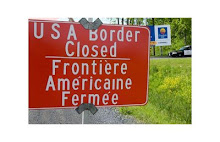
After a two month concession to the will of the Mohawk People the border crossing through Akwesasne is closed again. After the funeral of an elder back in July, the US Customs could no longer claim that they had to close the US side as a matter of international protocol after the Canadian Border Service abandoned their post on Mohawk land. Some behind the scenes waterboarding finally convinced Canadian Border Services to end the nonsense. So they set up a border station on the City of Cornwall side of the river, off the Akwesasne island of Kawenoke. The face-saving catch was that everyone who was only going to Kawenoke was told to proceed all the way on and off the island into the city of Cornwall, report and then return to Kawenoke. Of course, the absurdity of this condition was not missed by the Mohawk people and thus the "new rule" was neither taken seriously nor followed. So now after two months of noncompliance to these morons and their new rule, the Canadian officials began a new push on the people of Akwesasne. A few days ago it was announced that people who entered Kawenoke from the Southern bridge that refused to proceed directly off the island over the Northern bridge into the City of Cornwall to report to Canadian Border Services that they in fact had no desire to enter into Canada but were only going to Kawenoke, would be charged with unlawful entry and have their vehicle seized. Yesterday the seizures started. After a half dozen or so vehicles were seized tensions were growing. Today both the Southern and Northern bridges to the Mohawk island are closed by US and Canadian law enforcement. Keep in mind this all stems from the Mohawk people refusing to allow the Canadian Border Services to establish a permanent armed presence on Mohawk land. Apparently, the Department of Homeland Security and the Canadian Border Service felt that two months of summer travel was enough to quiet the complainers in the City of Cornwall crying about the economic impact of the bridge closure. Or perhaps Albany's share of the Akwesasne Mohawk Casino met its milestone for the quarter. Whatever the case, it is clear that the squeeze on the Mohawk people is not over.

Monday, September 14, 2009

The Seneca Nation Formally Submits to DHS Pressure on ID's

Well, it is confirmed! The Seneca Nation of Indians has formally announced its plans to develop a Department of Homeland Security compliant Enhanced Tribal Card. They even give it its own set of initials like FBI, DHS, BIA and IOU. They are called, what else, ETC's. Sorry Scott, your Dad didn't tell you the whole truth. He didn't just agree to add an expiration date. No, these cards will be scannable, have digitized photos with specific biometric coded measurements and have RFID chips (see the link to RFID Chips on the side bar at "What They Say"). This way your identification can and will be broadcast to check points, police or any other receiver devices the state/provincial and federal governments decide to use and install. Oh yeah, they will also have expiration dates on them.
For those of you that say, "So what? What do I have to hide? I don't care if I am tracked and identified where ever I go", the best is yet to come. The final requirement of the DHS for a Western Hemisphere Travel Initiative (WHTI) compliant ETC is a declaration of citizenship. No, we aren't talking about Seneca Nation citizenship. This is it; once and for all. Are you an American or a Canadian? This time the Seneca Nation is overtly complicit with US and Canadian officials in this game of assimilation and semantics. Of course, no one is forced to get these cards, only those that may want to cross that border that was never intended for us (...for now). Ironically, the Seneca Nation of Indians can't afford to issue these cards so to add insult to injury, the Seneca Indians will have to pay individually for the right to comply with the feds and obtain their own ETC.
So let's hear it for those defenders of Sovereignty and Native rights. If you are not a member of the Seneca Nation of Indians, fear not. The Saint Regis Indians, the Oneida Indian Nation of New York and the Haudenosaune (otherwise known as Onondaga, et al) are right in line (as well as every other federally recognized tribe). And guess what? You get to have your "Nation's" logo on the card (maybe even your Indian name). No one will ever know you finally declared your subjugation to your oppressors. Hell, you won't even have to show the card. It will transmit who and what you are from your pocket.

Friday, September 4, 2009

A Reprint of an April 2009 Post

The case referred to here was opposed at a public meeting but filed anyway on August 5, 2009. A look back at this post is relevant in light of the lust for a Sullivan County casino.

Although there is much that will remained unanswered here, we now have a better understanding of what makes up some of the beliefs of a Saint Regis Indian.
Some of the things we don't know include; who are the Saint Regis Indians, when did they come into existence and just who are the Seven Nations of Canada that these Saint Regis Indians owe some element of their existence to?
Based on a civil action that these Saint Regis Indians, also known as the Saint Regis Mohawk Tribe (SRMT), plan to file in US Federal Court and statements made in a public meeting to discuss this filing, we now know things that were perhaps not understood about these people before.
This is what is learned from the draft of a planned civil action by the SRMT:
The SRMT derives its authority from the US Federal government as a federally recognized Indian tribe. The SRMT believes that "the exercise of jurisdiction within an Indian reservation in New York is exclusively governed by federal law". The SRMT believes that an Indian reservation was established for the use of the Indians of the Village of Saint Regis in 1796 by an agreement between New York State and Seven Nations of Canada. The SRMT believes that New York State made this agreement "In an effort to set aside land for the Mohawks that would be federally protected from encroachment". At some point that is not clear in this filing, the SRMT believes that this "reservation" became the "federal reservation" of the SRMT. The SRMT believes that the US Constitution provides them with the right to bring this action and that United States District Court for the Northern District of New York has jurisdiction because "the Tribe's reservation is located in that District". The SRMT also believes that the "Tribe's reservation" is in New York State's Franklin and St Lawrence Counties and that land that was attempted to be carved out of the interior of the "reservation" by the State is part of the Town of Bombay. The SRMT believes that the Congress of the United States has never "enacted any law or statute or taken any other action to diminish the Tribe's reservation." The SRMT wants a federal judge to declare "that the jurisdiction of the Tribe, the State and the local governments within the Hogansburg Triangle(land within the "Tribe's reservation") is governed by federal law". Although they ask for a "grant of such other relief as the court may deem just and proper", one can't help wonder why they didn't ask for recovery of the taxes they paid in the purchases they made for property in the "Hogansburg Triangle".
In the public meeting to discuss the filing of this case it was also learned that SRMT and its legal counsel believes that it is unlawful for Native retailers to sell products to non-natives without collecting tax for the state. This begs the questions about the SRMT's involvement in this unlawful activity. We also learned that the SRMT believes that the only thing that keeps the State or its counties from siezing land in Akwesasne for taxes is a "gentleman's agreement" that the "Tribe" has with them not to do so.
It must be noted that in spite of the addition of the word "Mohawk" to the name of the Saint Regis Indians, there is no claim in this filing that the SRMT is or represents the Mohawk Nation, the Mohawk People or the Kanienkehaka or is a part of the Six Nations, Iroquois Confederacy or the Haudenosaune. On a historical note there is also no mention of any of these entities in the agreement of 1796 cited in the filing nor is there an established connection between these and the so-called Seven Nations of Canada. A reason for this may be because a federal court ruled in a previous attempt by the SRMT to use the court that Saint Regis Indians are not recognized as Mohawks and cannot use a connection to the Mohawk Nation or the Six Nations for their defense. On this one point many Kanienkehaka can agree with the findings of a federal court.
This civil action planned by the SRMT is a land claim. As can be clearly noted from previous posts on Native Pride, this is not "Land Claims; Mohawk Style". Within the lines delineating New York State, not one acre of land has ever been reacquired in a federal court or a court filed land claim. Only Ganienke and the recent reclamation in Akwesasne have resulted in the return of lost land to the people.
This post comes a long way from defining what a Saint Regis Indian is, but it should be clear that Saint Regis Indians are not Mohawks. They are, apparently, Americans; something a Mohawk would never claim.

Saint Regis Tribe Trying to Sell Out The Mohawk People...Again

North Country Public Radio, September 1, 2009
Last year, Governor Paterson signed into law a bill that would enforce collection of state tobacco taxes when non-natives buy cigarettes at native-owned stores. Albany estimates up to 400 million dollars a year in taxes are going uncollected. But like his three predecessors, Paterson’s administration said last week it will not try to collect the taxes. Remember when the Seneca Nation burned tires on the Thruway when then-Governor George Pataki tried to collect them? The whole issue is knotted up in lawsuits. New York City is suing a Long Island tribe. Two counties are suing the Cayuga Nation. The rulings could set precedents in the now cloudy case of tobacco taxes and native tribes. Jim Ransom says there’s an easy solution – sit down and talk. Ransom is chief of the St. Regis Mohawk tribe in Akwesasne. The Mohawks are at odds with New York State over three issues – the cigarette taxes, land claims in St. Lawrence and Franklin counties, and building a casino in the Catskills. Ransom says one agreement can resolve them all.


That giant sucking sound is the State and federal government sucking on Ransom hoping the load he drops has the last remnants of Mohawk sovereignty neatly within it. The short-term instant gratification will be the Tribe's credit for putting a Casino in the Catskills. Ransom says he doesn't understand all the fuss over taxing the Mohawk people and Mohawk land claims. A Saint Regis Casino in the Catskills can fix it all. He brags about how successful the Tribe has been in meeting the demands of the State in the past. Joseph Brant would be proud. This will be the greatest sellout of the Mohawk People since he sold 9 million acres of Mohawk land for $1500. The beauty of this deception is that Brant had no more authority to claim to represent the Mohawk Nation than Ransom does. The last time the Saint Regis Tribe tried to claim to be the Mohawk Nation using a handful of Six Nation treaties to defend themselves, a federal court slapped them in the mouth and ruled against them, stating for the record that they were not Mohawks, but rather Saint Regis Indians. Perhaps Ransom will get his image carved into the White man's history, monuments and buildings just as Brant did.

Sunday, August 2, 2009

Native to Native Business: We Need to Defend and Redevelop the Concept

It is imperative that we identify, oppose and ultimately rid ourselves of any of the obstacles preventing Native to Native commerce. Even as states and their federal government continue to work to deny our free access to the American market, we need to draw an even more indelible line when it comes to interfering with Our commerce. No state should be allowed to dictate to a Native person the terms by which they can purchase, sell or otherwise trade with another Native person or in another Native territory. We are consumers of goods. For the most part, most of our consumption takes place off our territories. We need to network both as consumers and producers to ensure that we are keeping the dollars amongst us through as many exchanges as possible. We need to identify the products and services our people need most and work to anchor our businesses with Native clientele.
Even the Nation enterprises have a role here. Let the gaming enterprises promote each others facilities. Learn from and teach each other the tricks for success. Promote and carry Native products in the Nation gaming and retail facilities. For those Nations with a successful private sector, demonstrate the value and the strength that comes from it. Keep in mind that not all services or development require the expansion of Nation employment. Contracts for anything from travel to lawn care can create a private sector business opportunity.
We need to look for future opportunities. Gas, Gaming and Cigarettes have been done and while our place in these industries needs to be defended, asserted and even grown, we need to move beyond them. World class Flea Markets networked across Indian Country could serve as incubators for Native retailers. Products from artisans to farmers could be afforded the best physical and electronic means to get their products to market. Other types of development centers for business and technology should capitalize on our regulatory advantages. Such facilities could help to bring in leading edge manufacturing and investment, in particular from Native people. Green technologies and sustainable enterprises, with a look forward and more scrutiny of our past, should present genuine opportunities for the future. Asserting our role as the Earth's Care Takers should be a task we take seriously. Our future may depend on it in more ways than one.
We shouldn't be adopting an isolationist policy or attitude towards our commerce with the non-native community, but we need to re-establish our relationships and not allow ourselves to be separated socially, culturally or economically from each other. Defending our commerce with the non-native public can only be strengthened by a strong Native to Native economy. There should be a social component to our business development. Perhaps the dollar isn't the bottom line. Economic profitability is certainly relevant and extremely important, but the need to provide products and services truly needed by our people must be considered. As consumers we have to decided if saving a buck at Walmart or McDonald's is worth the trip, especially if it tips the scale for viability of a local business.
Let's begin a process of reassessing our needs and relationships. Let's really consider who and what we want to support.